

Two accordions can have the same number of keys and bass buttons, similar dimensions, and almost identical appearances. Yet when you play them, one may sound broader while another feels more focused. One may respond comfortably to a quiet phrase, while the other may feel quite different under your hands.
Why do similar accordions sound different? The answer involves the reeds, the combinations selected by the registers, the tuning, the instrument’s construction, and its present condition. How the accordion fits the player also influences the experience.
Understanding these differences helps you compare instruments more thoughtfully. It can also help you describe what you like about your own accordion—and what you would like to understand better.
Start by Listening to the Accordion’s Overall Voice
Before focusing on specifications, listen to how the instrument speaks. Does the sound feel warm, bright, dry, lively, focused, or broad? Does it remain balanced as you change registers or bellows pressure?
These impressions are useful starting points, but they become more meaningful when connected to specific features such as reed combinations, tuning, response, and condition. A familiar melody can reveal more than a quick demonstration of every register.
The Same Number of Keys Does Not Mean the Same Instrument
A specification such as “41 keys and 120 basses” describes important parts of an accordion’s layout. It does not fully describe its sound.
The treble side may contain different sets of reeds, often called voices. Register switches select individual voices or combinations. Two instruments with similar keyboards may therefore offer different musical possibilities.
Even the number of register switches needs context. Some switches can duplicate a combination for convenient access. More switches do not necessarily mean more distinct sounds.
When comparing accordions, establish which voices are sounding. Comparing a single voice on one instrument with a fuller combination on another can create a misleading impression of their underlying character.
Accordion Tuning Shapes the Character of the Sound
When two reeds sounding close to the same pitch play together, the small difference between their frequencies produces an audible pulsation, or tremolo. The amount of this effect is an important part of an accordion’s musical character.
Players often describe tuning as dry or wet. Broadly, drier combinations have little or no tremolo, while wetter combinations have more pronounced pulsation. Terms such as swing and musette also appear in discussions, but descriptions alone are not a substitute for listening.
An accordion with a lively tremolo is not automatically out of tune. That sound may be intentional. Equally, a strong tremolo does not prove that every note is behaving as intended.
The useful question is whether the tuning suits your music and is consistent with the intended character of the instrument. Bring a familiar musical example when discussing sound preferences; it is often clearer than relying on a label alone.
Reeds and Construction Work Together
Reeds matter, but a reed description is not a complete assessment of an accordion. Their behaviour must be considered within the assembled instrument.
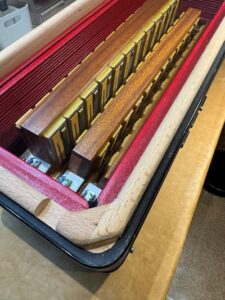
One construction feature you may encounter is a cassotto, or tone chamber. It changes the tonal character of the voices placed within it, commonly giving them a mellower sound. Voices outside the chamber can provide a contrasting brightness.
This is a musical choice rather than a requirement for every player. Someone looking for a particular mellow voice may value it greatly; another player may prefer a different character.
Listen to the registers you actually expect to use. A feature that looks impressive on a specification sheet is useful when it supports your playing.
How Reed Response Affects Playing Comfort
Tone describes the character you hear. Response concerns how the instrument reacts when you play.
During a comparison, notice whether you can start a quiet phrase comfortably, shape a sustained note, and move between notes with control. Try a familiar melody slowly before playing something fast. A slow passage gives you time to notice details that a busy demonstration can hide.
Pay attention to how readily the reeds speak at different bellows pressures. An accordion that responds easily to gentle playing may feel very different from one that seems to need more air or pressure before the note becomes clear.
The keyboard or button action also affects the experience. Travel, resistance, and consistency can make one instrument feel more natural to your hands than another.
A sound recording can introduce you to an accordion’s voice, but it cannot tell you how the action feels or how quickly the reeds respond. Where possible, give yourself time with the actual instrument.
Condition Can Change the Comparison
An instrument’s original design and its current condition are separate considerations. An older accordion may have changes in tuning, sticking keys, or air leakage that affect the playing experience.
Difficulty playing softly, an uneven note, or unexpected air consumption does not identify one specific fault. These observations are reasons for assessment, not a diagnosis by themselves.
Our earlier article, Why an Accordion Can Deteriorate Even When It Is Not Being Played, explains why appearance and limited use do not establish internal condition.
When considering a used instrument, ask what has actually been inspected or serviced. It is helpful to understand whether you are hearing the intended sound of the instrument or a sound influenced by unresolved maintenance issues.
Compare Accordions Under Similar Conditions
A useful comparison does not require a complicated test. It requires a little consistency:
- Use the same short piece. Choose music you know well so you can concentrate on the instrument.
- Compare corresponding registers. Identify the voices selected rather than relying only on register names.
- Listen at more than one volume. Include gentle playing as well as a fuller passage.
- Test reed response. Begin notes softly, increase bellows pressure gradually, and notice how evenly the sound develops.
- Try melody and accompaniment together. Consider whether the balance suits the way you play.
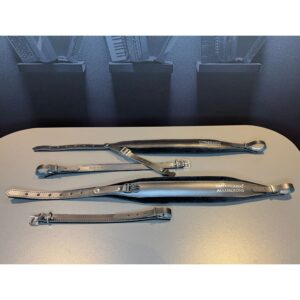
- Allow time for fit. Position and support affect comfort and control; our article on accordion straps discusses this aspect of the playing experience.
If comparing recordings, keep the room, microphone position, and recording settings as similar as possible. A recording made close to one instrument and across the room from another is a comparison of recording conditions as well as accordions.
Choose for Your Music and Your Hands
A useful accordion comparison separates three questions: Do I like its sound? Can I control it comfortably? Is it in appropriate condition?
It can also help to ask whether the tuning, reed response, register choices, and physical setup support the music you want to play. The instrument with the most features will not necessarily be the one you enjoy playing most.
A teacher can help you evaluate suitability for your repertoire and progress, while a technician can assess mechanical condition and discuss realistic service or tuning options.
At AccordionShop.ca in Mississauga, Ontario, we help players across Canada with accordion selection, tuning, and service. If you are comparing instruments or have noticed a change in your accordion’s behaviour, learn about our accordion repair and tuning services and contact us to discuss your instrument and musical needs.